What is reseller hosting?
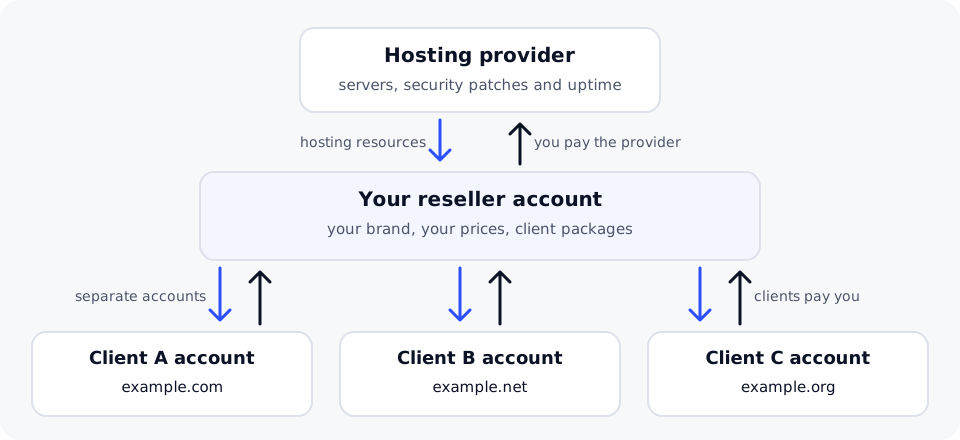
Reseller hosting lets you sell web hosting to your own clients under your own name. You buy a share of a hosting provider's servers, divide it into separate accounts, and offer those accounts to the people you build or look after websites for. This guide is for agencies, freelancers and web designers who are deciding whether reseller hosting is the right way to host their clients' sites.
How reseller hosting works
With ordinary web hosting, one account usually belongs to one person or business. With reseller hosting, you get a larger allowance of resources, such as disk space and the number of accounts you can create, plus a reseller control panel: a management area where you create, change and close hosting accounts for your clients.
Each client gets their own separate hosting account. Their files, databases, email and settings stay apart from everyone else's, so a problem in one client's site does not spill into another's, and each client can be given access to their own account only.
What white-label means
White-label means the service carries your brand, not your host's. Your clients deal with you: they see your business name, your prices and your support details. The hosting provider stays in the background and runs the servers.
In practice, white-label usually covers:
- Your branding in the control panel your clients sign in to.
- Your own prices, which you set and invoice yourself.
- Your own nameservers, such as
ns1.example.comandns2.example.com, so even DNS lookups show your domain. See Set up custom nameservers.
Who reseller hosting suits
Reseller hosting is a good fit when you already look after websites for other people and want to offer hosting as part of the service. For example:
- Web design and development agencies that build sites and want to host them in one place.
- Freelancers who maintain a handful of client sites and want a simple monthly charge for hosting.
- Marketing and IT consultants who manage online presence for small businesses.
If you only run your own sites, a regular web hosting plan or a VPS is usually simpler. A VPS (virtual private server) is a server of your own that you manage yourself.
Who is responsible for what
Reseller hosting splits the work between you and your host. Being clear about this before you take on clients avoids surprises.
| Task | Your host | You |
|---|---|---|
| Servers, hardware, network and data center | Yes | |
| Server software, security patches and uptime | Yes | |
| Creating and managing client accounts | Yes | |
| Setting prices and billing clients | Yes | |
| First-line support for your clients | Yes | |
| Helping clients with their websites, email and DNS | Yes | |
| Escalating server problems to the host | Yes |
Your clients will contact you, not your host. You answer their questions, and when something points to the server itself, you raise it with your host and pass the answer back.
Plan your packages
A package (sometimes called a plan) is a preset bundle of resources that you assign to a client account, such as disk space, monthly data transfer, number of email accounts and number of databases. Packages keep things consistent and make upgrades simple.
When planning packages:
- Start with two or three tiers, for example a small package for brochure sites and a larger one for online stores.
- Base the limits on real sites. Look at how much space and traffic your existing client sites use.
- Leave headroom. The total of all client packages can exceed what you have bought, because most sites do not use their full allowance, but keep enough spare capacity for growth.
- Write down what each package includes so your clients know what they are paying for.
Pricing considerations
How you price hosting is a business decision, but a few points apply to almost everyone:
- Cover your real costs: the reseller plan, domains, any software you use for billing, and your own time for support.
- Decide what is included. Some resellers include small content updates or website maintenance; others charge separately for anything beyond hosting.
- Choose a billing cycle, such as monthly or yearly, and say clearly when renewals happen and what they cost.
- Plan for upgrades so a client who outgrows a package can move up without a migration.
Terms of service for your clients
Because you are the provider your clients deal with, you need your own terms of service: the agreement that sets out what you offer and what clients may and may not do. Your terms should be at least as strict as your host's acceptable use policy, because your clients' accounts must follow your host's rules too.
Typical topics include acceptable use, payment and late payment, suspension and cancellation, backups and who is responsible for restoring data, support channels, and privacy. Ask a legal professional to review your terms if you are unsure.
DomainPilot reseller hosting comes in four plans, Reseller 25, 50, 100 and 200, named after the number of client accounts. Every plan includes a white-label control panel with a separate account for each client, your own branding and prices, free SSL for every client site, daily backups, domain reselling and free migration of client sites. Custom nameservers and billing software integration are included from Reseller 50, and a dedicated IP address and priority support from Reseller 100. See DomainPilot reseller hosting.